One Ongoing Story, Read Again on Sunday
A weekly routine for revisiting a developing story helps you track what changed, what remains uncertain, and which questions still need answers.
By Sunday, the story you followed on Tuesday may have a new detail, a correction, or no meaningful update at all. A weekly routine for revisiting a developing story can help you separate what changed from what merely sounded new, while keeping unanswered questions visible. The aim is not to read every update. It is to understand how the account is taking shape.
Choose one story that is likely to continue unfolding: a local school closure, a court case, a labor dispute, or a public agency decision. Then choose a reading rhythm that fits your attention. You can make a brief change log, compare a small set of reports, or keep an open-question note. Each approach has a different strength, and none requires you to treat every update as equally important.
Which Sunday reading approach fits your week?
A routine should be small enough to repeat and structured enough to make change visible. Pick one approach for a few Sundays rather than combining every tool at once. A paper notebook works well if you like to think away from screens; a notes app or a saved folder can help if you want links close at hand.
- Use a change log if you want a clear record of what is newly reported and what has been corrected.
- Compare a few reports if you are unsure whether different outlets are describing the same development in the same way.
- Keep an open-question note if the central difficulty is knowing what the reporting still cannot answer.
These are alternatives, not a test of how serious a reader you are. A person following a neighborhood transit proposal may want the change log. Someone tracking a disputed claim may prefer the comparison. If the story has little verified movement, an open-question note can keep uncertainty from turning into speculation.
How do you make a useful change log?
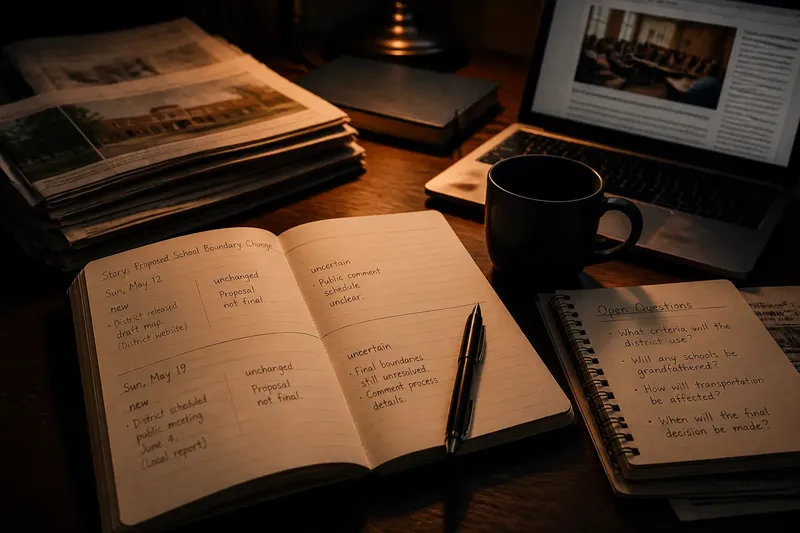
Write the date you are reading and the story’s current subject in a few words. Under that, use three short labels: “new,” “unchanged,” and “uncertain.” Add only details that affect the account, not every fresh quote or repeated background paragraph.
For “new,” record the development and where you saw it. For “unchanged,” note an important point that remains consistent across the material you read. For “uncertain,” write what is still not established, such as whether a decision is final or whether a reported figure has been independently confirmed.
Keep the wording modest. “The agency announced a hearing” is more useful than “the agency is about to reverse course” unless the latter is explicitly supported. If a report corrects an earlier detail, preserve the correction in the log rather than silently replacing the old note. That way, you can see how the account changed and avoid remembering the first version as though it were always settled.
Say you are following a proposed school boundary change. On one Sunday, you note that the district has released a draft map, that the proposal is not final, and that the schedule for public comments remains unclear. The next Sunday, a new report says the district has scheduled a meeting. Your log records the meeting as new, keeps the map’s draft status under unchanged or uncertain as appropriate, and leaves the final boundaries unresolved. The observable benefit is a cleaner distinction between a procedural update and a final decision.
When should you compare a few reports?
Use comparison when one report leaves you wondering what another account emphasizes or whether an apparent contradiction is real. Choose a small set of pieces that address the same development. Include a local or specialist outlet when it has relevant access, and look for a primary document or official notice when the story turns on the wording of a decision.
Read for the claim each report makes, the material it points to, and the limits it acknowledges. One outlet may describe a proposal; another may focus on a response to it. Those accounts can differ in emphasis without disagreeing about the underlying event. Before treating them as conflicting, check whether they cover the same date, decision, and stage of the process.
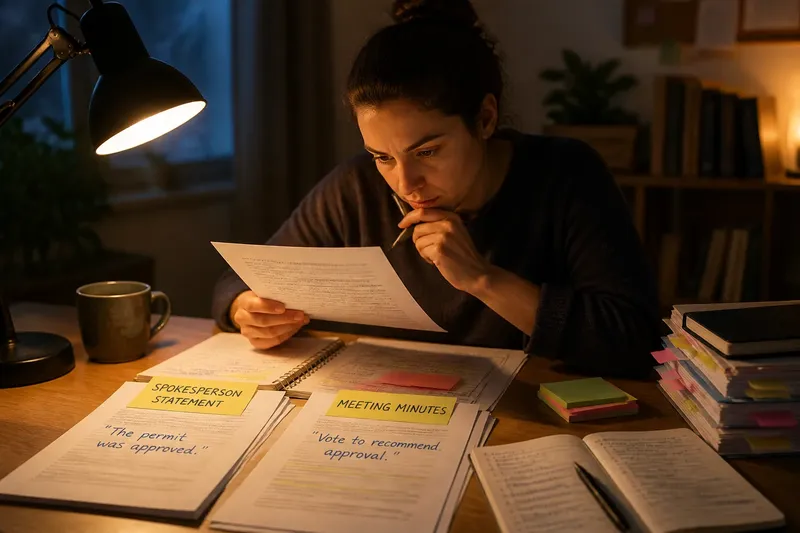
A simple comparison table can help. Make columns for “claim,” “support mentioned,” and “what remains open.” Keep the entries brief. If one article says a committee approved a measure and another says the measure awaits a final vote, the difference may be about which stage “approved” refers to. Find the specific action in the article or linked record before drawing a broader conclusion.
Comparison suits readers who have enough time to read more than one account and a story where wording or emphasis matters. It is less useful when several outlets are repeating the same announcement without adding reporting. In that case, following the original notice and waiting for a substantive update may be more informative than collecting more versions of the same sentence.
What questions are still worth carrying forward?
An open-question note is useful when a developing story has gaps that may not be resolved in the current reporting. It prevents an unanswered question from quietly becoming an assumption. Write questions in plain language and keep them specific enough that a later report could answer, narrow, or leave them open.
What has actually changed since the last reading?
Look for a new action, document, decision, or verified detail rather than a sharper headline or a fresh reaction. If nothing substantive changed, write that plainly and return to the story when there is a reason to do so.
Which parts are confirmed, and which are still attributed?
Separate what a record or direct statement establishes from what a source says happened or expects to happen. Attribution matters because a reported claim can be relevant without being independently settled.
What would answer the question I still have?
Name the kind of information that would help, such as a final vote, a published policy, or a response from a named organization. This keeps the question concrete without assuming that the information will appear or that one source will settle every point.
What would make me revise my current understanding?
Identify a meaningful development that could change your view, such as a correction to a central detail or a newly available record. If no plausible update would alter your interpretation, consider whether you are following the story out of habit rather than because it still matters to you.
How can you keep Sunday reading from becoming a scroll?
Give the routine a stopping point. Reopen the saved article or source you last relied on, check for a clear update, then consult one additional account or document if the new detail needs context. Save links with a short note about why each one matters; a browser bookmark titled “latest” is less helpful than “meeting notice” or “correction to timeline.”
Do not treat a quiet week as a failure of your routine. Some stories pause while institutions deliberate, records are prepared, or people involved decline to comment. Mark the gap, and decide when you have a reason to check again. You might return after a scheduled meeting or a stated deadline rather than refreshing feeds throughout the week.
It also helps to distinguish a development from a reaction to one. A new statement may add a perspective without changing what has been decided. Note who made the statement and what it addresses, then leave the status of the underlying issue intact unless the statement supplies new evidence or a formal action.
What should you do with a correction or a quiet week?
If a report corrects a detail, note both the corrected point and what the correction changes. A small correction to a name may not alter the story’s central account; a correction to the date or status of a decision may matter more. Do not infer intent from the existence of an error. Track the change in the information and keep your own conclusion proportionate to it.
If there is no update, write “no substantive change noted” and close the note. That phrase describes your reading, not proof that nothing happened elsewhere. You can check again when a meaningful event is expected, or let the story rest if it no longer affects a question you care about.
For a developing story, the most useful Sunday habit is not gathering the largest pile of links. It is leaving yourself a clear record of what changed, what remains uncertain, and what could answer the next question. A brief note like that makes it easier to return later without mistaking repetition for progress or an open question for a settled fact.